Mission Overview
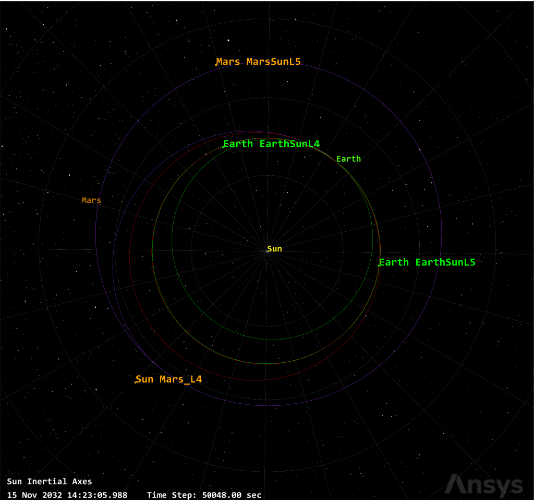
As orbital analysis lead, I designed the constellation architecture and led all trajectory and coverage analysis for Cerberus a three-satellite heliocentric constellation built for the AIAA 2025–2026 Undergraduate Team Space Design Competition. The mission requirements were uninterrupted solar weather monitoring and continuous Earth–Mars communication relay from 2036 to 2049, within a $400M USD budget.
The Problem I Was Solving
Earth and Mars experience approximately six super solar conjunctions during the mission window events where the Sun blocks all direct radio contact between the planets for days to months at a time. My task was to design a satellite architecture that eliminates these blackouts entirely, guaranteeing an unbroken relay chain regardless of where Earth and Mars sit in their orbits.
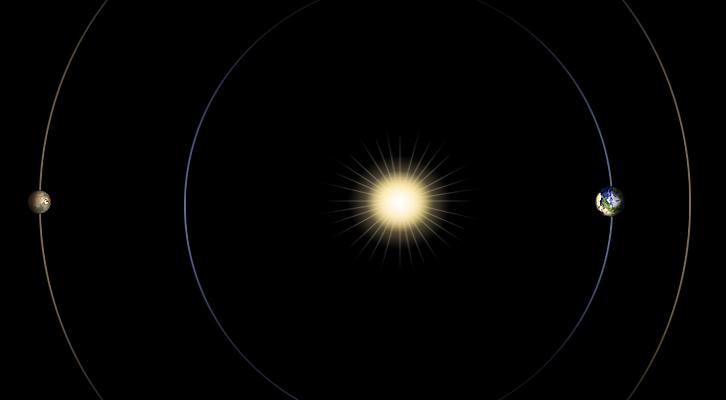
Figure 2 - Mars and Earth during a super solar conjunction, illustrating the communication blackout geometry.
Architecture Decision
I settled on a three-node design Earth-Sun L4 (relay), Earth-Sun L5 (solar observer), and Mars-Sun L5 (Mars observer and relay). Placing nodes at these positions guarantees continuous heliocentric arc coverage of roughly 240°, keeping adjacent-node separation below 90° at all times and maximum inter-satellite range under ~290 million km within the capability of the free-space optical link I specified.
Orbital Trade Study & Constellation Design
With a 15-year mission life and tight propellant budget, I needed positions that were inherently stable rather than relying on continuous station-keeping. I evaluated all five Lagrange points for both the Sun–Earth and Sun–Mars systems, ruling out L1/L2/L3 due to their saddle-point instabilit they require active correction roughly every 23 days, which is unsustainable at interplanetary distances. Mercury-Sun and Venus-Sun L4/L5 were also eliminated for excessive thermal loads and ΔV requirements.
L4 and L5 are the only Lagrange points where balanced Coriolis and centrifugal forces create a true potential well, making small perturbations produce bounded libration rather than escape. The Sun–Earth and Sun–Mars mass ratios both exceed the ~24.96 threshold required for this stability, so I selected Earth-Sun L4, Earth-Sun L5, and Mars-Sun L5 as the three station positions each geometrically fixed at 60° offsets in their respective planetary orbits with minimal propellant for the full mission window.
Node Roles
Each node was assigned a specific function, with position chosen to maximise the mission's dual objectives:
Earth-Sun L4
Communication relay. 60° ahead of Earth closes the Earth–Mars relay chain when direct line-of-sight through the Sun is blocked.
Earth-Sun L5
Primary solar observer. 60° behind Earth, it sees 60° of Sun invisible from Earth and delivers 4–5 extra days of CME warning due to solar rotation.
Mars-Sun L5
Mars relay and solar observer. Monitors solar activity toward Mars and bridges the communication gap during Earth–Mars conjunctions.
STK Modelling & Coverage Analysis
I built the full constellation model in Ansys STK, placing all three spacecraft in a Sun-centred inertial reference frame and propagating each orbit across the complete 2036–2049 mission window. The core deliverable was proving that no communication blackout would occur that the relay chain between Earth and Mars remained unbroken at every point in time, including during all six super solar conjunctions.
Access Analysis
I ran access computations between all node pairs to extract continuous line-of-sight intervals across the mission window. Two access plots were the primary proof of coverage: Earth-Sun L4/L5 to Mars-Sun L5 (confirming the interplanetary relay chain is uninterrupted), and Earth-Sun L4 to Earth-Sun L5 (confirming constant contact within the Earth-local cluster). The results showed maximum adjacent-node separation stayed below 90° and maximum inter-satellite range under ~290 million km throughout validating the architecture against the communication link budget.
Stability Verification
I propagated each spacecraft's trajectory in STK over the full 15-year mission duration to verify bounded libration rather than drift or escape. This confirmed that the L4/L5 positions produce the stable co-rotating equilibria expected from theory, and that station-keeping ΔV requirements remain minimal a critical result for validating the propellant budget and mission feasibility within the $400M constraint.
Trajectory Design & ΔV Optimisation
I designed all three interplanetary transfer trajectories in STK, using departure true anomaly as a free variable and sweeping it to minimise total ΔV while satisfying the hard constraint of launch no later than 31 December 2035. The Earth-Sun L4 and L5 transfers were designed as TLI-analogue escapes from a low-Earth parking orbit; the Mars-Sun L5 satellite required a dedicated trans-Mars injection trajectory.
Departure Parking Orbit
All three spacecraft share the same initial parking orbit before their injection burns. The Keplerian elements below define the departure state used as the starting condition in STK for each trajectory optimisation.
| Parameter | Earth L5 | Earth L4 | Mars L5 |
|---|---|---|---|
| Semi-Major Axis (km) | 6,878.14 | 6,878.14 | 6,878.14 |
| Eccentricity | 0 | 0 | 0 |
| Inclination (°) | 23.5 | 23.5 | 23.5 |
| RAAN (°) | 0 | 0 | 0 |
| Argument of Perigee (°) | 0 | 0 | 0 |
Table 1 - Shared departure Keplerian elements for all three Cerberus transfer trajectories.
Transfer Paths & Window Selection
For the Mars-Sun L5 satellite, I identified six viable Earth–Mars launch windows between 2031 and 2039 in STK and selected the optimal window to minimise ΔV while meeting the deadline. All three trajectories were visualised simultaneously in the Sun-inertial frame to verify that the paths don't intersect each other or the Trojan asteroid populations at Earth-Sun and Mars-Sun L4/L5 - a non-obvious risk for these specific destinations.
Launch Vehicle Trade
I led the launch vehicle trade study, evaluating four candidates against the $400M total mission budget: Falcon Heavy ($150M/launch, 16.8 t to TMI), New Glenn ($110M/launch, 10 t to TMI), Vulcan ($150M/launch, 1.3 t to TMI), and Starship (~$10M/launch, ~15 t to TMI with one refuelling). Falcon Heavy, New Glenn, and Vulcan each would have consumed over half the entire programme budget in launch costs alone, leaving no margin for development. Starship was the only vehicle that could deliver the Mars-L5 payload mass to trans-Mars injection while keeping launch costs a small fraction of the total the decisive factor in selecting it.